Showing posts with label Episcopal Church. Show all posts

Saturday, July 18, 2015

Celebrating Our Baptismal Identities: A TransEpiscopal General Convention Wrap-Up


As we hit the two-week mark from the ending of the 78th General Convention of The Episcopal Church, I look back on those nearly two weeks in Salt Lake City with a sense of gratitude for what the Church accomplished. We elected Bishop Michael Curry the new Presiding Bishop. We passed legislation in support of the rights of immigrants and refugees. We passed a new initiative on racial justice and reconciliation. We began the process of shifting our own structure as a General Convention. We passed legislation moving us clearly into the path of liturgical marriage equality.

We also passed several trans- affirming resolutions. In fact, all of the resolutions that TransEpiscopal was there to support (a list of which you can find here) passed. Two of these looked beyond the borders of TEC: A051 (“Support LGBT African Advocacy") and D028 (“Oppose Conversion Therapy”). Another pair, A073 and A074, called for “the creation of inclusive policy and practices in regard to LGBTQ and gender variant individuals" as part of a broader update of TEC’s call for an update of TEC's Model Policies & Resources for the Prevention of Sexual Misconduct and Abuse of Youth and Children.

The two resolutions on which we focused the most strongly were about name changes: D036 ("Adding Name Change Rite to the Book of Occasional Services”) and D037 (“Amending Names in Church Records, Registries and Certificates”).


As reported earlier, a number of people, both trans and cisgender, spoke at the open hearing on this resolution before the Committee on Prayer Book and Liturgy. All testimony was supportive—no one spoke in opposition. The testimony was also well received, and the committee supported the resolution strongly. They voted it forward to the House of Bishops with an amendment that we felt good about as well. The original wording of the resolution called for the planned expansion of the Book of Occasional Services to include a particular name change rite from a resource entitled Changes:Prayers and Services Honoring Rites of Passage. The amended version of the resolution opened that process, inviting the revisers of the BOS to consult both that rite and other rites. Other rites they might consult, for instance, include the one in Justin Tannis’s pioneering 2003 book. This amended version of D036 then passed both the House of Bishops and of Deputies on their respective consent calendars. This means that the resolution was basically considered so non-controversial that it could simply be approved without discussion. Very good news!

So we are on our way to having a widely accessible name change liturgy in The Episcopal Church. Over the next three years, as the Standing Commission on Liturgy and Music (SCLM) revises the Book of Occasional Services, it will incorporate a name change liturgy. At the next General Convention the SCLM will present its revised BOS to the 79th General Convention in Austin, TX and will call for its approval. In the meantime, for those interested in using or putting together a name change rite, you too might consult the two above mentioned sources, among others: Changes  and Justin Tannis’s book.


Like D036, D037 also passed both Houses and is now an act of the General Convention.
D037 addressed the pastoral need for TEC to respond to requests by those who have had a legal name change to amend names in church records and to reissue certificates. It calls for the church to study what canonical issues—if any—there may be to fulfilling such requests. It also called for trans people to be consulted as part of that study, since the resolution itself was generated precisely by the experiences of trans people in our church—by people requesting a new baptismal, confirmation, or ordination certificate after they have legally changed their name, for instance.

Like D036, this resolution was supported by powerful testimony during the open hearing process, this time before the Committee on Structure and Governance. Again, all testimony at this level was supportive, and the committee was glad to move it forward in the legislative process. And as with D036, the committee amended its language. The substance of the resolution stayed the same—the changes simply impacted what other committees should help plan and execute the study. While D036 traveled first to the House of Bishops, D037 began its road in the House of Deputies .

Unlike D036, however, D037 was discussed on the floor of Convention (and not only in the open hearing process). This, too, was a good thing. On the whole, the debate was supportive with some constructive criticism:

  a deputy from the diocese of Fon du Lac spoke in support of the resolution and told a powerful story that underscored the broad range of people potentially impacted by this resolution. After her husband left the family, the deputy explained, the local Episcopal church took the family under its wing. Her daughter, for whom the father’s departure had been especially difficult, eventually sought to be baptized. But because we don’t currently have an official policy about how name changes impact our historical church documents, the daughter didn’t want to risk having her dad’s last name on her baptismal certificate: she waited until it was legally changed to her mother’s maiden name before proceeding. (All of us in the gallery were very moved by this testimony.

a deputy from Michigan wondered why this needed to be studied when it so clearly referenced a pressing pastoral need. Why wait three years when people need clarity now? (Listening from the gallery, we sympathized—we want the clarity now as well, but we also want this to be done right.)

Deputy Fredrica Harris Thompsett from the Diocese of Massachusetts made the connection between this resolution and the power of baptismal naming. She expressed a desire that everyone might be able to proudly hang their baptismal certificate on the wall reflecting their current identity. If study is indeed necessary, she as an historian invited us to be open to the possibility that the process could widen our appreciation of the matter. And as a theological educator she underscored that studies are not necessarily a bad thing. (In the gallery, we very much agreed on all counts.)

a deputy from Pittsburg proposed an amendment adding the officers of the national Episcopal historians and archivists to the list of those involved in the study. She did so after expressing a concern to be careful about “altering historical records after the fact.” (In the gallery we supported the idea of having historians and archivists involved—we too feel the need to be careful about this. We also have particular insights on how our histories impact us in the present that we look forward to sharing as the study is conducted.)

a deputy from Colorado supported the amendment and also identified with the resolution as a cisgender woman who changed her baptismal name several years ago. Although she goes by a different name now, she explained, that doesn’t erase the history of her life prior to her current name. Retaining records of aspects of personal and corporate history is a good thing, she concluded. (Again, those of us in the gallery weren’t opposed to preserving necessary records. We simply want the Church to be very careful about how they are used in the present and future, to make sure that historical records are not projected into our present lives—or shared with others-- in ways that prevent us from free and full participation.)

The amendment was passed, followed by the full resolution. I don’t recall hearing any no votes. It then continued on to the House of Bishops where it was put on the consent calendar and passed on the last day of General Convention. I heard the news while I was at the airport waiting to board my flight.

* * * *

Now, two weeks out from the close of General Convention, as I think over all the amazing things that happened on so many fronts, and as I think about these particular resolutions that we put so much energy into supporting, I come back to Fredrica’s testimony in the House of Deputies. We are a people who have striven, who are striving, to claim and fully move into our baptismal identities. In this we stand with many—indeed, with all the body of Christ – and we share much even in the midst of some differences. And because of how we stand in the midst of that larger body we are reminded that we are always amid the already and the not yet. These resolutions are now entrusted to the General Convention and its (now shifting) interim bodies. They become the work of the Church, in progress, between now and 2018. Between now and 2018 we will join that progress, we will offer our support, insight, energy, and ultimately our trust. We look forward to having a name change liturgy in the Book of Occasional Services. We look forward to hanging our baptismal certificates on the wall. And while we still have much, much work still to do, right now let’s hang this General Convention on the wall—let’s celebrate. 

Friday, June 26, 2015

A Crack in Our Current Practice: A Trans Angle on Marriage Equality in The Episcopal Church

As TransEpiscopal celebrates today's Supreme Court decision honoring marriage equality, and as we join in supporting efforts toward full liturgical marriage equality in The Episcopal Church here at General Convention, we offer this essay from Iain Stanford who brings a trans angle to this conversation.

by Iain Stanford

Over the last several weeks, the blogosphere and Facebook have been alive with different opinions, questions and concerns about the various resolutions regarding  marriage equality in The Episcopal Church. As I read the various arguments, I keep wondering if people realize that we already have same sex couples in The Episcopal Church who were married using the service for Holy Matrimony in the Book of Common Prayer. Let me explain.

At the 77th General Convention of the Episcopal Church in 2012, the church spoke loudly in support of transgender people as full members of our Church by adding gender identity and gender expression to the non-discrimination canons. As a trans person, though, the canons for marriage and the use of the BCP can become a bit, well, surreal.

Take for example the fictional couple of Jim and Francine. On their day, they walk through the red doors and up the aisle, the celebration begins with the words from the BCP, “Dearly Beloved: We have come together in the presence of God to witness and bless the joining together of this man and this woman in Holy Matrimony.” (BCP 423) And a little later, the priest pronounces, “they are husband and wife.”  (BCP 428) Now several years go by, and Francine slowly acknowledges all those feelings when it comes to gender. All her life, people have asked, “are you a girl or boy?” She talks to friends, therapists, and yes, even her priest. Eventually, she knows that God is calling her to move forward, to become Francis. She does! After transition, they are now Jim and Francis. They live into what it means to be a same sex couple in society. And yes, they are still married in the eyes of the Church.

I can hear some people say, “But they came to the altar like any other heterosexual couple.”

Which begs the question: what is the connection between the outward and visible sign or signs of gender and marriage?

Ok, let’s take a more personal example, me! I am not married. When I was living in the world as a lesbian and partnered, I could not be married in the Church. At that time, I could only marry a man, but after my transition, everything shifted. Now I can marry a woman, but alas I can no longer marry a man. What exactly has changed?

The shift here is not a theological one. It is not about Augustine’s theology of the goods of marriage or even Elizabeth Stuarts’ theology of gay and lesbian relationships as “just friends.”  The shift is my physical body. My negotiation of gender has shifted from the outward and visible sign of a woman to that of a man, more specifically a trans man. My own sense of gender exceeds binary definition. I own my full gender history. My story, while common in trans communities, is not as well known outside of those circles. I am proud of the ways I participated in breaking down barriers for women in the 1980s, even if only in small ways. I was one of the few women who studied engineering in those years, and the first to be elected president of my university’s engineering honorary. Today, I live and move mostly as just another short white guy. To know me is to understand that I am the sum of all my years.

To my mind, the experience of transgender people in the Church reveals a crack in our current practice. The church is invested first and foremost in the simulacra of heterosexuality. It upholds heteronormativity:

One is born male, grows up to be a man, adheres to masculine gender norms, sexually desires women, and exercises this desire in a monogamous, life long committed marriage, which takes as its aim the procreation of children.

Or one is born a female, grows up to be a woman, adheres to feminine gender norms, sexually desires men, and exercises this desire in a monogamous, life long committed marriage, which takes as its aim the procreation of children.

Currently access to Holy Matrimony in the BCP requires the outward and visible sign of heterosexuality. Our practice – and our theology for that matter—assumes a stable gender identity that corresponds with assigned birth sex. Neither our practices nor our theology account for the experiences of transgender people, particularly those who understand themselves as having a non-binary gender.


Our current understanding of the human body in terms of sex, gender and sexuality has been shaped by various scientific, medical, and religious discourses over the last century or so. Terms like heterosexuality and its complement, homosexuality, emerge from the work of late 19th century sexologists like Havelock Ellis.  These terms give us a new way of describing how humans desire; they do not invent those desires. Similarly, over the last several decades, we have new terms to describe how people live out their genders.  

It is time we live into the full acceptance of all gender identities and gender expressions. Marriage is not about body parts. I am here to testify to this as a fact. It is first and foremost a vocation (as "Christian Marriage As Vocation," essay two from the Task Force on Marriage report, argues). It is a call from God for two people to join their lives in service to God, be that for the raising of children or for the uplift of all God’s creation.

Let us not forget: there are married trans Episcopalians who already hold out a glimpse of full liturgical marriage equality to our Church, even as there are other trans Episcopalians newly unable to access it. Now is the time to make full liturgical marriage equality real for everyone.


Tuesday, June 23, 2015

Held in the Balance - the Revd Gwen Fry on General Convention


by the Reverend Gwen Fry

Every time I look at the photo with me in the background on the TransEpiscopaal Facebook page and blog I remember how important it was for me to be there at GC 2012. You see, at that time I wasn’t what you would call an active member of TransEpiscopal, working on important legislation or volunteering at the TransEpiscopal booth in the exhibition hall. No, I was more of a lurker on the list serve and had been for a number of years. I was there to track legislation, however, and I was there to attend a very special Eucharist. And as it turned out, I was there to attend the triennial family reunion of the church. I attended General Convention 2012 in Indianapolis for very personal reasons.

Having no responsibilities at the convention as a visitor I was free to go from house to house observing our church at work. The first day I was there I immediately took note of the gender neutral bathroom facility strategically placed between the House of Deputies and the House of Bishops. I know, you’re thinking bathrooms? But for me that was an incredible statement my church made. The church that I grew up in, in a very tangible way, supported me and all gender non-conforming children of God.

Sitting in the galleries of both houses listening to the discussion on resolutions D019 and D002 filled me with hope for my church. The bishops and deputies who stood up in support of these resolutions was a powerful witness to the broad, inclusive church I was proud to be a member of. Even those who stood in opposition of these resolutions filled me with hope because we are not a monolithic tradition here in The Episcopal Church. It reminded me that the tent is indeed big and it reminded me that even with these nondiscrimination clauses added to the canons, we have much work left to do to gain true acceptance throughout the church. As the votes were cast and tallied in both the House of Bishops and House of Deputies there was a deep sense of gratitude, joy, and acceptance that washed over me. It was quite surreal actually. With this monumental decision (at least in my eyes) the Episcopal Church gave me the “cover” I thought was necessary for me to come out and live authentically after 21 years as a priest in the church.

The evening before I left the convention and headed for home, I attended the TransEpiscopal Eucharist. It was a perfect way to rejoice with others the incredible gains achieved at GC2012. It was also the first time I was in a room, worshipping with others, who knew me. Fully knew me. At that Eucharist I began a journey that brought me out of the shadows of lurking on a list serve. I was no longer on the sidelines of my community and stepped onto the playing field, simply by being known.

And so every time I see that banner across the top of TransEpiscopal’s blog or Facebook page with me standing in the background I am reminded of how far we have come as a church and how much I have grown. It hasn’t all been pretty or easy the past three years. There have been many losses and disappointments. There has also been resurrection and new life, in the church and personally.

Legislation is never antiseptic and removed from the lives of people. It is deeply personal and affects the lives of many whether we can see them or know them, understand them or even agree with them. Individuals like me are always held in the balance of the decisions we make as a church. Even as individuals like me are held in the balance by GC decisions, at the same time GC decisions do not necessarily prevent individuals from encountering difficulty. That experience certainly held true for me. It was most difficult to seek the dissolution of the pastoral relationship with a parish and people I deeply love and who loved me. We need to live into GC decisions, to engage and embrace them in our congregations and dioceses. What we do at GC truly does matter because of the connections between the layers of our church.
 

I look forward to joining my colleagues and friends of TransEpiscopal in Salt Lake City to continue our work in the church. I am attending this General Convention because it is personal. Because there will be others attending this year who are just like I was three years ago, desperately looking for a place to call home, feel the support of their church, and experience the transforming power of the love of God.

Trans Legislation at the General Convention: From 2006-2012 and Beyond


As the 78th General Convention approaches this week, here is a brief review of trans legislation that has come before the Convention in years past. As you can see from the shift between 2006 and 2012, and as previous blog posts narrate, we have come an incredibly long way. The five resolutions listed under 2015 begin to point to much work that we still need to do.

2006 

1)    C030 -- The Diocese of California referred a resolution to General Convention calling for the addition of “gender identity and expression” to the list of non-discrimination demographic categories in Canon III.1.2. The Committee on Canons took it up as resolution C030 (“On the Topic of Amending Canon III.1.2 [Of the Ministry of All Baptized Persons]”). As the legislative history reports, the committee recommended discharge and re-referral to the Committee on Ministry. As far as we know, that referral never happened, or was never acted upon by the Committee on Ministry. As the legislative history reports, “Resolution Died With Adjournment.”

2)    The Diocese of New York passed a resolution calling on TEC to come out in support of fully gender inclusive secular civil rights resolution (e.g. ENDA) but it got lost in the shuffle and somehow was never considered at this GC.

2009

1)    D090— encouraged inclusive self-identification on all church forms, creating flexible options for people to identify their gender, names, and preferred pronouns. A question that lingered for us was the problem of amending registries and having certificates reissued (e.g. baptismal, confirmation or ordination) upon request after someone has changed their name (which is why a resolution addressing that has been submitted to GC 2015)

2)    C048 put TEC on record in support of a fully trans inclusive version of the Federal Employment Nondiscrimination Act 

3)    D012 put TEC on record in support of fully trans inclusive nondiscrimination and hate crimes laws at the local, state and federal levels 

4)    D032 (Nondiscrimination protection for lay employees in TEC) – declared that lay employees in TEC are not to be discriminated against on the basis of several demographic designations, including gender identity and expression

5)    C061 Canon Change re: Access to the Ordination process passed the HOD but failed in HOB (HOB actually amended it and sent it back to HOD, which declined to concur) 

2012

1)    D002 added “gender identity and expression” to Canon III.1.2 re: nondiscrimination in access to discernment for the ordination process 

2)    D019 amended Canon I.17.5 (aka “the Rights of the Laity”), clarifying that “No one shall be denied rights, status or access to an equal place in the life, worship, and governance of this Church” on the basis of “gender identity and expression,” among a number of other demographic categories

3)    D022 called for a church wide response to the epidemic of bullying based on a number of categories, including gender identity and expression  


2015

1)   D036 "Adding Name Change Rite to the Book of Occasional Services”. This resolution calls upon the Standing Commission on Liturgy and Music (SCLM) to include the name change service from Changes: Prayers and Services Honoring Rites of Passage in its proposed comprehensive revision of the Book of Occasional Services (BOS). The rite is adaptable for various life and circumstances, including the name changes of trans people.

2)    D037 “Amending Names in Church Records, Registries and Certificates”. This resolution requests a study with recommendations to be brought to the 79th General Convention regarding the pastoral need to allow church records and registries to be changed and certificates to be reissued to reflect a person’s new legal name. It calls for several groups to be consulted as part of this process, including transgender people.

3)    D028 “Oppose Conversion Therapy”. This resolution seeks to put the 78th General Convention on record in support of legislation banning state-licensed therapists from engaging in scientifically discredited and dangerous practices that try to change a person’s sexual orientation or gender identity.

4) Addendum to Resolutions A073 & A074: these resolutions which call for an update of TEC's Model Policies & Resources for the Prevention of Sexual Misconduct and Abuse of Youth and Children have received an addendum that "calls for the creation of inclusive policy and practices in regard to LGBTQ and gender variant individuals." As the Standing Commission on Lifelong Christian Formation & Education's explanation goes on to say, "we would like to recommend that the 78th General Convention... call for the creation of model policies to support ministries that safeguard the dignity of our LGBTQ children, youth, participants, and leaders."

5) A051 "Support LGBT African Advocacy". This resolution, which went to hearing this morning (6/24), "encourage parishes, dioceses, especially those with companion relationships in Anglican Africa, as well as advocacy groups, to build relationships with African Anglican scholars and activists who are working to advance generous understandings of the Bible that affirm the dignity of lesbian, gay, bisexual, transgender, and intersex people."

Thursday, September 18, 2014

Voila! (one parish's rapidly achieved, relatively low key, and profound sign of welcome)

“Do we have a gender neutral bathroom?”

the new gender neutral restroom at
St. Paul's Episcopal Church, Salem, OR
“No, though there is the ADA-accessible bathroom by the sacristy.”

“Well, can we make that a gender neutral bathroom?  Can we order a sign this week?  If that’s what people need to feel safe, then that’s what we need to have.  And we need to advertise it.”

And voila.  St. Paul’s Episcopal Church in Salem, OR, was going to have a gender neutral bathroom in order to make sure trans folks knew they were welcome in the space.

How did we get here?  Let’s back up. 

I am one of two interim priests serving this good-sized parish in the capitol of Oregon, known throughout the state for the excellence of its music programs.  Worship is traditional, and conversation is lively.  The Very Rev. Lin Knight serves as interim rector.  He asked me to serve as associate beginning January of this year.  I asked him if St. Paul’s was ready for a 34-year-old tattooed lesbian priest, and he laughed.  I heard later he sold me to the staff as a “perky blonde.” 

Lin had served St. Paul’s nearly a decade ago as interim as well.  During this time, the Oregon Supreme Court ratified its Defense of Marriage Act (DOMA), prohibiting same-sex marriages in the state of Oregon.  Since St. Paul’s is in the capitol city, and since the Episcopalians had been getting a lot of press about the election of Bishop Gene Robinson, the paper called Lin to get a statement about this decision.  He told them that he believed the church should be in the business of strengthening all committed relationships. 

Well, I wasn’t here, but I heard this caused quite the kerfuffle.  Letters were flying. The senior warden asked that Lin make a public apology and state that he was speaking for himself only, and not the church.  The parking lot was on fire with chatter. Lin held the center with his signature grace, and eventually the parish calmed down, with many coming to him to thank him quietly for his words.

By the time I arrived, the church had settled into the place where I think many – if not most – Episcopal churches stand today.  Generally, most parishioners support full inclusion of cisgender gay and lesbian worshippers and clergy, and support efforts for full civil rights for GLBTQ folks.  They are stronger in understanding cis gay and lesbian issues than trans issues.  They are proud of being able to worship with people who may not be fully accepting of gay and lesbian people as well.

I was warmly welcomed and started the fun part of being an interim, which is getting to shake things up a little.   On occasion, I have been accused of preaching a “political” sermon.  (As has Lin.)  We’ve both been curious about this word, which is used primarily in the church as shorthand for, “What you are talking about makes me uncomfortable.  Please stop talking about it.”  It’s a silencing tactic rather than a meaningful adjective.  We thought we could explore that term in a non-defensive, open way over the summer.  We moved to a summer schedule and left an hour open before services for people to come in and have informal conversation about “political” topics.  We covered Israel and Palestine, Ferguson, immigration, climate change.  And for three weeks, we talked about sex. 

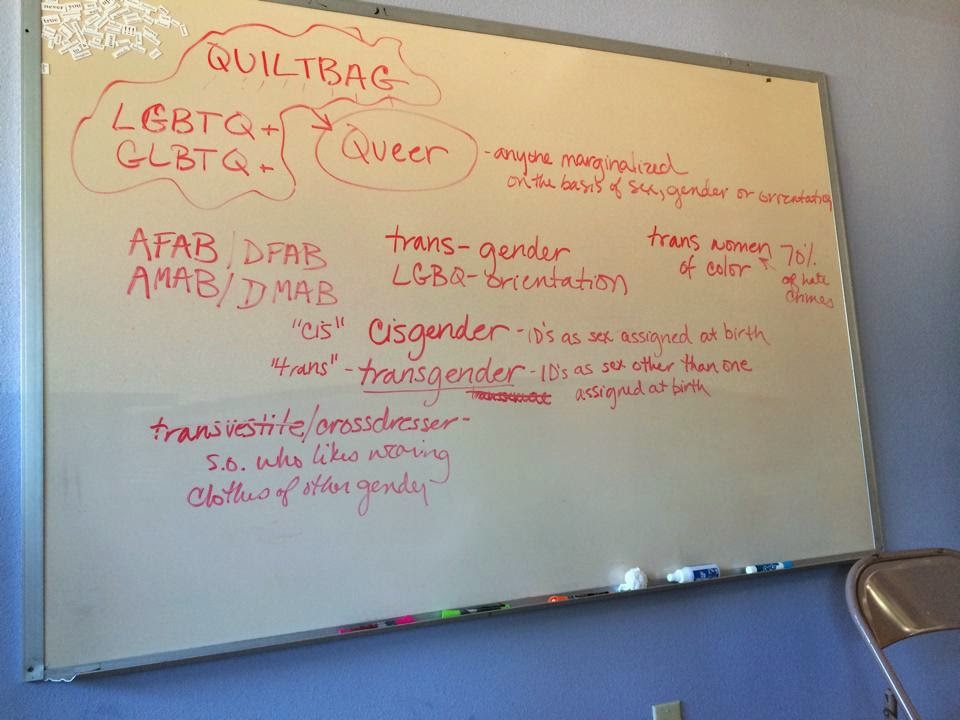
the whiteboard
(note: the term 'transvestite' is crossed out
because it is now considered derogatory) 
In one of those sessions, I did the world’s fastest Queer/Trans 101.  We defined terms, and moved quickly into talking about “queer” and “trans” as umbrella terms for a variety of identities.  (Many of them grew up hearing “queer” as a slur, and were very hesitant asking about it.  I said to not use it if it still carried negative connotations for them, but also explained how we need a word for, really, “everyone who gets beat up” as a result of sexual or gender identity.)  I made sure they knew that the vast majority of violence against queer folks happens to trans women of color. 

The white board with all the notes from this quick overview was left up all week, in the main meeting room of the church.  All the regular groups who meet there saw it, and it provoked a good deal of discussion on its own.  At staff meeting, on Wednesday, the parish administrator said that she had heard lots of people talking about it.  A few staff members chimed in and said they were curious, too.  I volunteered to answer any questions they might have, and off we went.  Eventually the conversation turned to welcoming queer folks at St. Paul’s, and we arrived at the conversation at the beginning of this post.  I had mentioned that one of the most contested issues for trans people is bathrooms, and our liturgical co-ordinator asked the opening question of this post. 

And there we were.  That part of staff meeting – from “So people have been noticing the white board…” to ordering a sign for the bathroom – took approximately ten minutes.   No mess, no months of agonized debate. 

Here’s what I think led to this easy ten-minute no-struggle conversation:

1. Calm clergy leadership, relaxed and committed to their values
2. Thoughtful, inquisitive adult faith formation unafraid of difficult topics
3. Most importantly, the laity’s absolute commitment to good manners and intentional welcome, even in a new situation where not everyone understands what the issues are

I think we forget about manners in the conversation about justice a lot.  Give me  staunch Christians with good home training any day when we’re faced with questions about how to be places of radical welcome.  By “manners” I mean that quality of a well-trained hostess, whose first priority is ensuring that her guests are comfortable and having a good time.  She may not appreciate someone’s taste, or personality, but as long as they are in her house, they will be made comfortable to the best of her ability.  It means the basic willingness to put another person’s needs before your own.  The St. Paul’s staff was still learning basic language and many of them have never knowingly met a trans person.  And yet – their number one concern was that people feel welcome in the space.  No questions on that front.  This is what someone needs to feel safe here?  We will provide it. 


This is the best of who we can be.  And on one sunny, sleepy, summer afternoon in Oregon, it meant a shift toward wholeness, and grace, for one community.  It meant marking one more little plot of land in this vast world as safe, as home. 

The Reverend Shelly Fayette, formerly the Interim Associate Rector of St. Paul's Episcopal Church in Salem, Oregon, is the new Rector of Christ Episcopal Church in Seattle, WA.  Congratulations, Shelly! 

Thursday, February 27, 2014

An Update on the Rev. Gwen Fry

An update to yesterday's statement:

Integrity USA and TransEpiscopal were saddened to learn that the Rev. Gwen Fry is no longer the Priest in Charge of Grace Episcopal Church in Pine Bluff, AR. We pray for healing for the Rev. Fry, for Grace Church, for the Diocese of Arkansas, and the wider LGBT community in the coming days and months.

We remain clear and confident that the wider family of the Episcopal Church and the Episcopal Diocese of Arkansas – including the Rt. Rev. Larry Benfield— embraces, supports, and is confident in the leadership of the Rev. Fry. We look forward to hearing about the next ordained position into which she will step in the Episcopal Diocese of Arkansas.

The events of this week point to the need for continued conversation and education on transgender leadership throughout the Episcopal Church. To aid in this process, IntegrityUSA and TransEpiscopal stand ready to offer a wide range of resources, including the short film Voices of Witness: Out of the Box.

This weekend Transfiguration Sunday will be observed across The Episcopal Church. We will hear the story of how Jesus walked up a mountain and was transfigured beside Moses and Elijah before three bewildered disciples. Only in Matthew’s gospel does Jesus bend down, touch them, and say, “Get up, and do not be afraid.”

This message could not be more timely today. As we stand together on God’s holy mountain, may we be strengthened to walk together through the challenges that lie before us, confident that in the process we will be changed into Christ’s likeness from glory to glory.

For further information/comment, please contact:

for IntegrityUSA
Mel Soriano, mel@integrityusa.org

for TransEpiscopal
The Rev. Dr. Cameron Partridge, cepart@yahoo.com
Ms. Donna Cartwright, donnamartina@gmail.com

IntegrityUSA & TransEpiscopal's original statement can be found here, including a statement from the Rev. Gwen Fry.

Monday, November 26, 2012

Pastoral Fallout: a Trans Perspective on Women Bishops

Rev. Dr. Christina Beardsley

The Reverend Dr. Christina Beardsley is an ordained priest in the Church of England, is a board member of Changing Attitude (which works for full LGBT inclusion in the Anglican Communion), and has served for a number of years as a hospital chaplain.  In the piece below she reflects on last week's vote by the General Synod of the Church of England which fell just shy of allowing women to become bishops there.  As she notes, because the various members of the Anglican Communion have somewhat different governing structures, women already are bishops in other parts of the Communion (e.g. Australia, the United States and, most recently, South Africa).  Her comments on the church's relation to equality legislation also reflect the fact that the Church of England is a state church. As we reflect with Tina, may we stand in solidarity with all in the Church of England who are struggling, who are angry, who are in pain.

CP

“Well, and which way did you vote?” The lady who asked me was sitting with an elderly friend in the High Dependency Unit of the hospital where I work. It was her first remark to me as I introduced myself as a hospital chaplain, the day after the General Synod’s recent vote on women bishops.

People are angry at the outcome – and rightly so. I explained that I hadn’t had a vote – not at the Synod anyway, but that as a member of a deanery synod I had voted in the clergy elections: ‘and it was passed in the House of Clergy’ I said encouragingly. She seemed to calm down then, knowing that I was ‘on side’. I think that it has probably shocked many women to see television clips of women arguing against the consecration of women as bishops. This lady clearly needed to check me out.

It wasn’t the place or the occasion though to talk about me, or my credentials as a supporter of women’s ordination, which go back a long way. I was there in my role as a chaplain and we quickly moved on to the needs of her friend.

Prior to transition I was a member of Priests for the Ordination of Women, and, of course, the ordination of women in the Church of England enabled me to remain a priest when I transitioned. Most of my working life, though, has been about pastoral care. It’s only in the last six years I’ve become an activist for LGB&T inclusion, and now that I have it’s probably too late to stand for General Synod, even if I wanted to (and I might not be elected anyway).

In any case I’ve felt very ambivalent about the General Synod since 1987, and the personal morality debate initiated by the Revd Tony Higton, which basically set the scene for the marginalisation of LGB&T people in the Church of England.


That catastrophe, combined with the painfully slow progress of the legislation on the ordination of women to the priesthood from the late 1970s onwards, means that I’ve never felt wholly confident in the processes and ethos of the General Synod. Perhaps I should have taken time to observe it at close quarters, but each time the Synod is in session I’m either working or elsewhere. Back in July, when the General Synod was meant to have voted on women bishops in York, I was at General Convention in Indianapolis, networking with the TransEpsicopal delegation.

What a contrast between General Convention 2012, where the three transgender inclusive resolutions were passed overwhelmingly by the House of Bishops and the House of Deputies, and the defeat, last week, of the women bishops’ legislation in the House of Laity of the General Synod!

Tina Beardsley in the Speaker's Corner at General Convention 2012 
On the other hand, the failure of the laity to meet the required two-thirds majority by just six votes was not a complete surprise. It had been evident for some time that this could happen. The legislation had been drafted, redrafted and amended several times, and it’s claimed that there was an orchestrated campaign in the last election to the House of Laity by those opposed to women bishops. If that’s true, it shows just how political the Synod has become, and how the moderate middle need to be more politically aware in future.

In many ways this was not so much a vote about women bishops but about the creation of a measure that could accommodate those – Conservative Evangelicals and Anglo-Catholics – who, for different reasons, would be unable to accept the ministry of a woman bishop. From the General Synod vote, and the voting by the dioceses (42 out of 44 in favour), it would seem that those opposed to women bishops are a minority; but the Church of England tries hard to hold on to its conservative minorities. I find that slightly uncomfortable when the Church of England seems to treat other minorities as expendable, though the principle is sound and could, and should, be extended.

What has shocked people about the latest decision is that a truth that has been hard won, and is now widely experienced in society in general, the equality of men and women, cannot be embraced by the church because of its tenderness to those with conscientious objections. Such tenderness is the Christian way set out by Paul in relation to dietary regulations in Romans 14-15.1 and 1 Corinthians 8, but not when it challenged the inclusive character of the gospel (Galatians 2.11-21). Parallel jurisdiction, which some of the opponents to women bishops appear to want, would likewise compromise the oversight of a woman bishop, leading to a two-tier episcopate.

This is the so-called ‘circle that cannot be squared’ which is plunging the Church of England into crisis. Since the Church of England is the Established Church of the land, the General Synod’s legal decisions are subject to scrutiny and ratification by Parliament and there is serious concern within Parliament about the Synod’s inability to progress the legislation in favour of women bishops.

There is talk of making the government’s experience in promoting equality available to the Church of England. Some MPs, and even bishops, are keen for the Church’s exemptions to equality legislation to be lifted. If this were to happen there would be a huge outcry from conservatives but it is something that I have longed for. Back in the late 1970s, when I was lamenting the Church of England’s slow progress towards enabling the ordination of women to the diaconate and the priesthood, the priest who was training me said this: ‘It was scandalous that the Church of England was granted exemption from the Sex Discrimination Act (1975).’

How right he was, and how important now for us, as LGB&T people, that ALL the Church’s exemptions should be removed, not just with reference to the Sex Discrimination Act, but to all the equalities legislation the UK Government has enacted in recent years. Only when the Church of England has finally embraced the principle of equality – which, after all, lies at the heart of the gospel – can it with integrity minister to the tender consciences of those who find such strong meat too hard to swallow.

Sunday, September 2, 2012

True Voice of Witness: Louise Brooks


Today the world lost a remarkable woman named Louise Brooks. I knew her through The Episcopal Church’s LGBT advocacy organization IntegrityUSA, for which Louise was the communications director over the last several years.  She brought to that role a long career as a documentary film-maker, journalist, activist and media-consultant.  Together with her wife, Integrity’s most recent president emerita the Reverend Canon Susan Russell, Louise brought impressive media sophistication to the organization’s communications.

I first met Louise in the summer of 2007 when I joined a number of LGBT and allied Episcopalians at a New York City roundtable as part of the Anglican Communion Listening Process on sexuality.  As I pulled up a chair to this proverbial table, Louise was among a cadre of formidable folks who welcomed me warmly.  I saw Louise the following summer at the “Fringe Festival” of the Lambeth Conference (the decennial gathering of bishops from around the Anglican Communion), and then a year later at the 2009 General Convention of The Episcopal Church.  It was there that we began talking more, and that the seeds were sown for what turned out to be – as far as I know – her last film project: Voices of Witness Out of the Box.

For the first time in 2009, Integrity and TransEpiscopal had brought several volunteers to the Convention to do advocacy and education on trans equality.  As part of that effort, Dante Tavolaro (Deputy from the Diocese of Rhode Island in both 2009 and 2012) and I led a “Trans 101” for the combined Integrity/TransEpiscopal team (you can catch bits of it in the video posted below).  About thirty or so people, including Louise, gathered in Integrity’s meeting room as Dante sketched out a simple grid or set of rules that went like this: in the West or Global North we’re assigned a sex at birth, either male or female; males are expected to grow up to be men, to “act like men”, and to date women. Those born female are expected to become women, to “act like women”, and to date men.  There are many ways to violate these rules.  To not act “like a man” or “like a woman” in your given context, to date people of your same sex, or to transition are just a few.  Gender theorists call this set of rules “heteronormativity.”  Christian theologians call it “complementarity.” Louise called it “the box.”  

As she put it in this May 15th preview, Louise left the 2009 General Convention committed to bringing this conversation, trans voices, and “the box” idea itself to the wider church.


About six months after GenCon 2009, Louise called me up to explore the idea for the documentary.  Could Integrity and TransEpiscopal work together on a film that showed not only how transgender people are “out of the box” but also — at least implicitly – how many other, nontrans people are out of it as well?   This film could convey both difference and connection—that trans people have different challenges than nontrans people do and at the same time that what can make life difficult for us also impacts everyone else.  We all live with the pervasive influence of that box which, crucially, intersects and assembles anew in conjunction with race, class, ability, and national origin.  We are connected in our struggle, even as we struggle in distinct ways.

As Louise ultimately described the project, "Gender identity and gender expression are issues that can easily be misunderstood and cannot be wrapped up in a neat little box.  So the goal of Out of the Box was to answer some of the most frequently asked questions.”  The simplicity of “the box” pointed to, opened – but did not seek to plumb – the complexity underlying it.

We talked and emailed about the film at several points between 2010 and last winter.  When I learned that Louise was ill, I suspected the film would need to go on hold, perhaps indefinitely.  But then, seemingly out of nowhere, Out of the Box roared to life.  In early February I flew out to Los Angeles for a day of filming.  Louise seemed totally in her element.  She was fatigued but connected and absolutely focused.  In between the interviews we talked about the upcoming General Convention and about Macky Allston’s powerful film Love Free Or Die that had just been released.  I was honored and grateful to be part of this work, curious and excited about its potential impact.

What I hadn’t realized was just how steeped in transformation this film was from the start.  Shortly after its release on May 31st, I saw a HufPo blog post by Louise’s wife (and major Out of the Box supporter) Susan Russell.  Susan explained, “what we found in Anaheim in 2009 was that the presence of members of TransEpiscopal testifying in committee hearings, participating in round-table discussions, speaking their truth, and sharing their lives created a profoundly teachable moment that quite literally changed lives.”  But what really struck me was the next sentence: “And one of those was my wife.” “Now,” Susan continued, “I have a hard-and-fast rule to never blog about my wife, but this blog is going to be the exception that proves the rule. A long-time activist, journalist, documentarian, and media consultant, Louise was convinced that gay, lesbian, and bisexual equality was a hard enough row to hoe without adding the ‘T’ into the mix. ‘Let's fight one battle at a time’ pretty much summed up her position -- that is, until the 2009 General Convention and the powerful witness of the transgender folk who so courageously shared their stories, their experience, their journeys, and their reality with her. She left Anaheim committed to finding a way to get their voices out beyond the relatively small audience of an Episcopal General Convention team -- and the idea for the documentary film project Voices of Witness: Out of the Box was born.”


I read that and was speechless.  It’s one thing to talk about transformation – I hear the word all the time, and I preach it, too – but seeing it, hearing an authentic story of it, experiencing it just takes my breath away.  I had not understood what a profound impact we had had on Louise.

But in retrospect, as I contemplated Susan’s words, it made sense.  Or at least, it explained more fully the deep sense of connection, the passion with which Louise pursued this project.  It very clearly mattered to her at a deep level.  When she said she was making the film as a gift to the church, you could tell she really meant it.  And it truly was. 

I was concerned to learn that Louise was too ill to attend General Convention this past July, but I was far from surprised that she was present all the same.  She was on the phone with the communications team every day.  She was making things happen.  We were all pulling for her, and she was most certainly pulling for us. 

You hear a lot of people described as “fighter.”  “He/she was a fighter.”  I am not someone who knew Louise from Adam, but it seems clear to me that she was indeed a fighter.  She fought for me and so many others.  But there was a heck of a lot more to Louise than that, and I don’t know even a quarter of it.  What I do know, though, is that Louise was a woman of profound compassion, open to being transformed, and passionate about opening that process to others. 

I will always be grateful for her support and solidarity, and my heart is with Susan Russell, with All Saints Pasadena, and IntegrityUSA in this time of loss.  May light perpetual shine on Louise.

CP
Susan Russell and Louise Brooks